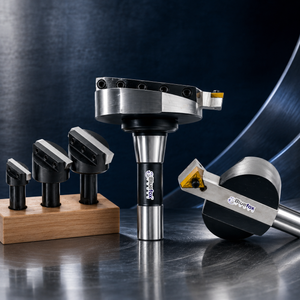
Parting Tool Holder

Abstechstahlhalter

Verbessern Sie die Leistung Ihrer Drehmaschine mit unserer Premium-Kollektion von Abstechhalterungen, die für reibungslose, präzise und stabile Abstichvorgänge entwickelt wurden. Diese Werkzeughalter wurden für manuelle Drehmaschinen, CNC-Drehzentren und Industriewerkstätten konzipiert und gewährleisten eine starre Klemmung, reduzierte Vibrationen und saubere, gratfreie Abstiche.

Hergestellt aus gehärtetem legiertem Stahl und präzisionsgeschliffenen Komponenten, bietet jeder Abstechhalter eine ausgezeichnete Haltbarkeit, Hitzebeständigkeit und langfristige Zuverlässigkeit. Ideal zum Einstechen, Nuten und Abstechen verschiedener Materialien wie Stahl, Messing, Aluminium und Edelstahl, bieten sie eine gleichbleibende Schneidleistung sowohl bei leichten als auch bei schweren Bearbeitungsaufgaben.

Geeignet für Maschinenbediener, Werkzeugmacher, Fertigungsbetriebe und Ingenieurwerkstätten, bieten unsere Abstechhalter eine sichere Verriegelung, genaue Ausrichtung und schnelle Werkzeugeinrichtung – was die Produktivität und Schnittleistung steigert. Ob Sie Präzisionsabstiche oder tiefe Einstiche durchführen, diese Kollektion bietet stabile, industrietaugliche Halter, die für professionelle Metallbearbeitungsergebnisse entwickelt wurden.

Erweitern Sie Ihre Drehmaschine mit unseren Hochleistungs-Abstechhaltern, die für Präzisionsschneiden, reibungslosen Betrieb und zuverlässige Bearbeitungsgenauigkeit entwickelt wurden.

FAST DELIVERY

1–2 working days delivery
across the .

NO HIDDEN CHARGES

All prices include VAT.
No customs, no surprises.

PROFESSIONAL QUALITY

Premium tools trusted
by engineers & craftsmen.

SUPPORT

Real support from
our team.

Häufig gestellte Fragen

Chatter is almost always caused by a lack of rigidity. Check to ensure your tool overhang is as short as possible, verify that your lathe spindle bearings are tight, reduce your spindle speed, and ensure you are feeding the tool with consistent pressure without hesitation.

Yes, copious amounts of cutting fluid or coolant are highly recommended when parting steel. Coolant flushes chips out of the deep, narrow groove, lowers temperatures at the blade tip, and prevents the material from welding itself to the tool edge.

T-shaped parting blades feature a hollow-ground top profile that provides excellent side clearance. This prevents the sides of the blade from rubbing against the walls of the slot as it deepens, drastically reducing heat buildup and binding risks.

High-Speed Steel (HSS) blades are highly resilient, shock-resistant, and cost-effective, making them excellent for manual lathes and interrupted cuts. Carbide inserts excel in rigid CNC environments where high speeds, high feeds, and extreme thermal resistance are required.

For general cut-off operations, grinding the front edge square (zero-degree lead angle) is best because it forces the tool to plunge straight. A slight lead angle can be ground if you want to eliminate the small burr or pip that is typically left on the finished part.

Absolutely. Parting tools and grooving tools share very similar geometries. A parting tool holder is perfectly suited for plunging precise, straight-walled grooves into cylindrical components.

As a general rule, run your lathe at roughly half the speed you would use for a standard turning operation on the same material. Slow speeds prevent tool overheating while allowing positive chip formation.

Signs of a dull blade include excessive chatter, a distinct squealing sound, a rough
surface finish on the walls of the cut, or the tool pushing the material away rather than producing cleanly curled chips


To fit different lathe sizes and tool posts cleanly, we offer tool shanks tailored for both compact and mid-sized machines. Our catalog includes the specialized 12mm x 8mm HSS Parting Off Tool System, alongside heavy-duty 10mm and 12mm adjustable and clamp-type straight shank holders.

Our Clamp Type Lathe Parting Off Tool Holders (such as our 10mm shank model) utilize a flush, top-down parallel clamping plate rather than standard pointed set screws. This distributes clamping force completely evenly along the top spine of the included 3/32" x 1/2" x 4" HSS blade, reducing vibration and preventing the blade from
cracking under load.

Available in both 10mm and 12mm shanks with a 3/4" (19mm) HSS blade, our adjustable parting holders feature a built-in pivoting block mechanism. This allows you to fine-tune and shift the vertical center height of your cutting edge cleanly without needing to add or subtract thin metal shims beneath your tool post.

The T63 Parting Tool Holder is precision-engineered specifically as a dedicated drop-in spare for T-63 Quick Change Tool Post systems. It is a perfect fit for classic setups like the Boxford Lathe and similar light-to-medium precision center lathes, and it comes complete with a matched 1/8" parting blade.

Mini lathes (like Unimat, Emco, or standard 7x14 bench lathes) lack the mass of industrial machinery and are highly prone to vibration. The low-profile 12mm x 8mm shank system features a compact, rigid clamping block that shortens the tool overhang distance, effectively stabilizing the cut-off plunge on lighter machine beds.

Our parting and cut-off holder kits come completely equipped with premium M2 High-Speed Steel (HSS) blades. M2 HSS provides an excellent balance of extreme toughness, heat resistance, and structural flexibility, meaning it absorbs shock without shattering—making it ideal for manual lathes and interrupted cuts.

Yes. Parting blades function identically to narrow plunge-grooving tools. The rigid vertical alignment provided by our 10mm and 12mm clamp-type blocks allows you to accurately plunge deep, clean, straight-walled grooves into steel, aluminum, brass, or plastics for retaining rings and seal channels.

All Bluefox Tools parting holders are machined from premium, heat-treated alloy steel blocks. The structural steel is hardened to withstand the immense vertical down-force generated during a deep cut-off plunge without twisting or warping out of square.

If the cutting edge of your blade rests even a fraction above the workpiece center line, it will rub against the material near the and stop cutting. If it sits below center, the rotating bar stock will ride up over the tip, pulling the blade downward and causing it to snap instantly. Use our adjustable models or a QCTP holder to lock it perfectly on center.

Always clean out packed metal chips from the clamping channel after use to ensure the next blade sits perfectly square. Keep the blade cutting edge sharp; if you notice a rough surface finish or increased chatter, use a fine aluminum oxide grinding wheel to re-dress the front face of the M2 HSS blade.

Maximizing Rigid Efficiency with Precision Parting Tool Holders

In metal-turning operations, parting off—or cutting off a finished component from a solid bar stock—is widely considered one of the most stressful tasks performed on a lathe. Because the cut-off blade plunges deep into the center of a rotating workpiece, the operation is highly susceptible to tool deflection, structural chatter, and blade breakage. To overcome these forces, machinists rely on an industrial-grade parting tool holder designed to clamp the cutting blade with absolute rigidity while keeping it perfectly perpendicular to the spindle axis.

At Bluefox Toolmart, we provide an advanced lineup of parting blade blocks, quick-change tool post blocks, and specialized cut-off assemblies designed for manual engine lathes, mini lathes, and high-production CNC setups. By optimizing your tool rigidity, you can achieve cleaner cuts, reduce material waste, and vastly extend the lifespan of your high-speed steel (HSS) and carbide parting blades.

The Dynamics of Successful Lathe Parting Operations

Unlike standard turning or facing, where forces are distributed along a broad path, parting concentrates all cutting forces onto a narrow, cantilevered blade. Without proper support, the blade can wander, dive under the workpiece center line, or chatter violently, leading to catastrophic tool failure.

To avoid these common pitfalls, a robust parting setup relies heavily on your tool post infrastructure. Many professional setups opt for advanced quick-change tool systems to facilitate rapid height modifications and rock-solid clamping. For instance, machinists working on heavy industrial lathes frequently install a a t63 quick-change tool-post-set-5pcs-colchester-bantam-24mm to ensure massive clamping force and eliminate movement under heavy loads. Similarly, those utilizing standard medium-duty tool configurations can benefit from the structural stability offered by a t2-quick-change-tool-post-set-5pcs-26mm or a slightly expandedt2-quick-change-tool-post-set-6pcs-26mm system to keep their parting blocks firmly aligned.

Selecting the Right Parting Tool Holder for Your Machine

When configuring your turning center for efficient cut-off work, you must select a tool holder configuration that matches your lathe’s swing capacity, tool post height, and the material thicknesses you regularly cut.

Straight Shank Parting Holders

These standard blocks feature a rectangular steel body that drops directly into a conventional four-way tool post or quick-change turning holder. They lock the blade vertically using top-down set screws or integrated wedge clamps, making them excellent all-around performers for traditional engineering environments.

Rear-Mounted Parting Blocks

Mounting a cut-off tool on the rear cross-slide of a manual lathe is an excellent technique for reducing chatter. In this configuration, the tool is mounted upside down, and the lathe runs in its normal forward direction. The cutting forces pull the cross-slide down into the lathe bed ways rather than lifting the carriage, maximizing structural dampening.

Essential Best Practices for Chip Clearance & Lathe Parting

Achieving smooth finishes and preventing tool breakages during a deep cut-off plunge requires precise execution. Here are the core factors to monitor:

  • Set the Tool Exactly on Center: This is the most crucial rule of parting. If your parting tool is even a fraction of a millimeter above center, it will ride over the material as it nears the core, stopping the cut. If it is below center, the material will tend to climb over the blade, causing it to snap. Use a quick-change block to adjust the height precisely.
  • Keep Blade Overhang to a Minimum: Only extend the parting blade from its holder as far as absolutely necessary to clear the radius of the bar stock. Excessive overhang amplifies tool flex and induces chatter.
  • Maintain a Steady Feed Rate: Do not hesitate during a cut. Parting requires continuous, positive chip formation. If you stop feeding, the blade will rub against the material, work-hardening the metal and rapidly dulling your cutting edge.

To keep the rest of your machine workspace properly organized and aligned during setup, specialized alignment tools are invaluable. Utilizing a high-precision 3-inch-machinist-center-square-center-finder or a compact small-centre-square-1-12-inch allows you to verify stock centers quickly before plunging your tool. Furthermore, verifying that your machine components are perfectly square can be easily accomplished by maintaining a premium 4pc-precision-engineers-steel-square-set directly at your workstation.

Expanding Your Lathe Capabilities Beyond Parting

Once you have mastered rigid cut-off setups, you can enhance your turning capabilities by incorporating other specialized tooling configurations. For example, when setting up custom milling operations on your lathe bed or small mills, utilizing an er20-collet-adaptor-80mm-rotary-table-milling provides excellent concentricity for small workholding. For varied collet capacities, alternating between an er16-collet-adaptor-3-inch-rotary-table-workholding-set and an er16-collet-adaptor-80mm-rotary-table-milling-lathe gives you total flexibility when adapting diverse cutters and workpieces to your workspace.

Premium Tool Maintenance and Workholding Upgrades

A machine shop is only as precise as its finest inspection and clamping equipment. To ensure that your raw materials are mounted perfectly flat before parting or groove-turning, you should use reliable clamping fixtures like a universal universal-peg-clamp-work-holder-8-adjustable-pegs.

If you are dealing with premium workpieces that require ultra-smooth surface finishes free of tool marks, transitioning from a parting blade to a burnishing operation can elevate your workflow. Integrating a specialized lathe-surface-burnishing-tool-hrc18-68 or using a lathe-burnishing-tool-22x30mm-16x22mm-mirror-finish will give you that flawless, mirror-like aesthetic directly on your machine. For miniature engineering work, employing a scaled-down mini-lathe-roller-ball-burnishing-tool-20mm or its slightly expanded counterpart, the mini-lathe-roller-ball-burnishing-tool-25mm, provides the fine-tuned finish control demanded by modern manufacturing standards.